The bank said not yet: options for growing businesses
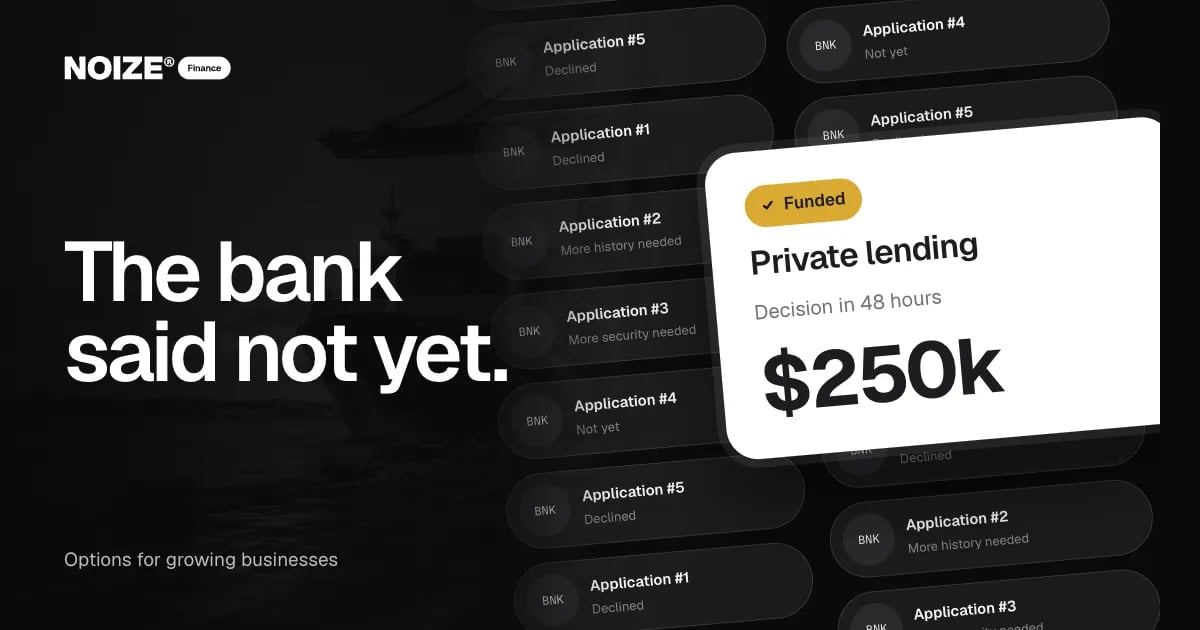
The first application was declined. The second needed more trading history. The third needed more security. The fourth was "not yet". Meanwhile, the opportunity the business wanted to fund is getting closer to slipping away.
The bank said no, or not yet. For many growing businesses, it is a familiar answer, and a discouraging one. But a bank decline rarely means the business is unfundable. It usually means the business doesn't fit that bank's criteria at that moment.
The short version
- Banks decline good businesses for reasons like short trading history, limited security, sector appetite or tight timelines.
- Non-bank and private lenders assess differently and can often decide faster.
- They typically cost more, so they suit specific situations: time-sensitive deals, bridging, businesses building history or assets banks won't lend against.
- Understanding why the bank said no is the first step to finding the right yes.
- NOIZE provides administrative support and business strategy.
- Where work is outside our skillset, or the law requires it, we make sure an appropriately qualified professional is involved.
Why banks decline good businesses
01Short trading history
Banks often prefer several years of financial statements.
02Limited security
Many bank loans require property or substantial assets as security.
03Sector appetite
Some industries fall outside a bank's lending preferences.
04Timing
Bank processes can be slower than the opportunity allows.
05Recent changes
A dip in results, a restructure or a change in ownership can make a bank cautious.
What non-bank and private lenders offer
- Different criteria. They may weigh cash flow, assets or the opportunity itself more heavily.
- Speed. Decisions can be faster, sometimes quickly.
- Flexibility. Structures can be tailored to the situation.
- Higher cost. Interest and fees are usually higher, reflecting the risk and speed.
When private lending makes sense
Bridging a gap until longer-term funding is available. Time-sensitive acquisitions or property purchases. Businesses with strong cash flow but limited trading history. Funding against assets banks don't favour. Short-term needs where speed outweighs cost.
When to keep working with the bank
If the business is close to meeting bank criteria, improving records, building history or adding security may be worth the wait. NOIZE Finance can help assess which route makes more sense.
> I've co-founded companies that were declined by banks in their early years, despite strong cash flow. Private funding bridged us through. Once we had the history, we refinanced to cheaper bank lending. The key was treating the private funding as a step, not the destination.
“Things really got moving beyond our expectations.”
An illustrative example
Picture a two-year-old business with strong monthly revenue offered a chance to buy a competitor's equipment at a discount. The bank wants more history. A private lender assesses cash flow and the equipment value and approves funding quickly. Eighteen months later, with more history and stronger statements prepared by NOIZE Accounting, the business refinances to a lower-cost loan.
Mistakes to avoid
- Don't apply to lender after lender without understanding why you were declined.
- Don't use expensive short-term funding for long-term needs without an exit plan.
- Don't overlook the total cost, including fees.
Make your broker's life easy
After a decline, the next application has to be stronger, and presentation is one of the easiest things to improve. A tidy, complete pack shows the business has listened and prepared.
Include the reason for the previous decline and what has changed, alongside current financials, BAS, a forecast and the use of funds. Our dedicated broker can then approach the right alternative lender with confidence.
How NOIZE Finance works with you
How the work is shared depends on the business. We agree what makes sense at the strategy or proposal stage, depending on the business and the opportunity. For some clients it is an introduction to our dedicated broker. For others it is a conversation about how to approach a lender, help structuring the information, or preparing the full funding pack with Books and Accounting.
Questions to ask after a decline
- What reason did the lender give?
- Is it something we can fix, such as records, history or security?
- How quickly do we need the funds?
- What would the total cost of alternatives be?
- How would we refinance later?
- Is our funding pack complete and well organised?
The answers help decide whether to wait, improve the application or explore other lenders with our broker.
Where to start this week
Write down why the bank declined, in the bank's words if you have them. That reason points to the right alternative and to what would improve your chances next time. See finance.noize.com.au.
How Finance connects to the rest of NOIZE
Every department leans on the others, and this one is no exception. NOIZE Accounting prepares the statements and forecast. NOIZE Legal coordinates the paperwork when a deal is involved, with an appropriately qualified professional where required. Finance helps bring it all together in a way that suits the client, from an introduction to our dedicated broker to a complete, organised funding pack. When every department contributes, the business presents as what it is: well run and worth backing. NOIZE Strategy defines the plan and use of funds. NOIZE Books keeps the records current.
Related reading
- Capital for the next move: matching funding to a clear use of funds
- Growth tied up in stock and receivables: working capital explained
This article is general information only. It is not legal, tax or financial advice, and it does not take your circumstances into account. Speak to a qualified adviser before acting.
NOIZE provides administrative support and business strategy. Where work is outside our skillset, or the law requires it, we make sure an appropriately qualified professional is involved.
Common questions
Why did the bank decline my business loan?
Common reasons include short trading history, limited security, sector appetite, recent results or timing.
What is a non-bank lender?
A lender that is not a bank, often with different criteria and faster processes.
What is private lending?
Funding from private lenders, often secured, used when speed or flexibility matters.
Is private lending more expensive?
Usually, yes. It suits specific situations where speed or access outweigh cost.
Can I refinance private lending later?
Often. Many businesses move to cheaper funding once they meet bank criteria.
Will multiple applications hurt my chances?
Repeated applications can affect how lenders view you. A targeted approach is better.
How fast can private lending be approved?
Sometimes quickly, depending on the lender and documentation.
What does NOIZE Finance need from me?
What the funds are for, how much, when you need them and your financial records.
Does NOIZE work with a broker?
Yes. We have a dedicated broker, and we can help however suits you, from an introduction to preparing your funding pack.
What is a funding pack?
A single, organised document with a cover page containing everything a broker or lender needs: summary, use of funds, financials, BAS, debtors, forecast and company details.
Does a decline affect my credit history?
Applications can be recorded, so targeted applications through a broker are better than many separate attempts.
What should a funding pack cover page include?
The business name, the amount and purpose of the request, a one-paragraph summary and a contents list.
Can we update the funding pack for future applications?
Yes. Keeping it current means the next application can go out quickly.
Does a good pack really make a difference?
Yes. Brokers and lenders are people, and complete, organised information makes their job easier and your application stronger.
Your first strategy conversation is on us.
Have a chatThe brand for business.